
Phthalic Anhydride Market to Reach 6.24 Million Tons by 2035 as Construction and Automotive Demand Drive Growth
Phthalic Anhydride Market (2026 - 2035)
North America is projected to grow at a 2.18% CAGR through 2035 as specialty organic chemicals demand rises
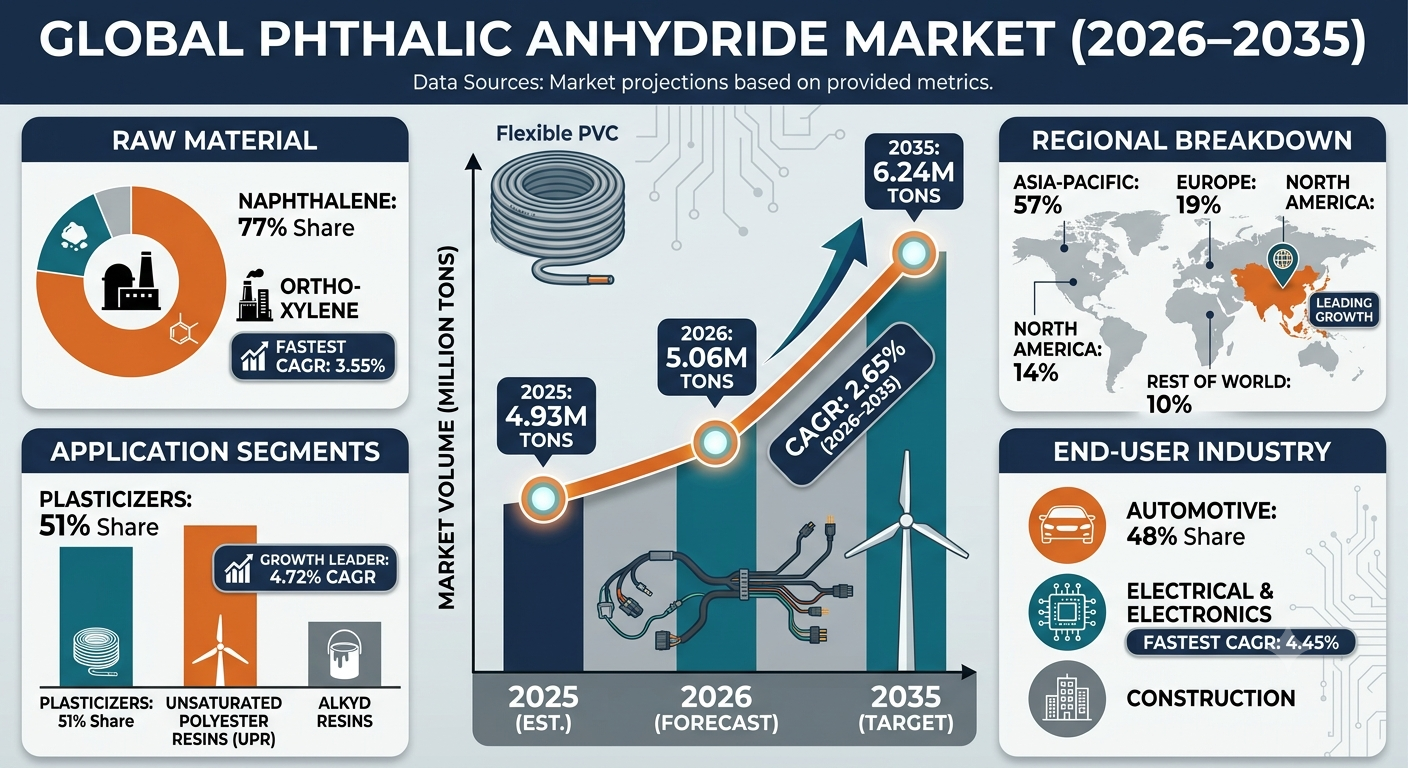
GERMAN, UNITED KINGDOM, August 24, 2026 /EINPresswire.com/ -- The global phthalic anhydride market is navigating a period of measured, structurally supported expansion. Estimated at 4.93 million tons in 2025, the market is projected to grow from 5.06 million tons in 2026 to approximately 6.24 million tons by 2035, registering a compound annual growth rate of 2.65%. While the headline growth rate appears modest, the market remains a foundational pillar of the global chemical intermediates ecosystem, underpinning plasticizer chemicals, coating resin materials, and unsaturated polyester resins that serve construction, automotive, and wind-energy industries.Feedstock Transition: From Coal-Tar Naphthalene to Refinery Ortho-Xylene
The production technology landscape is undergoing a quiet but consequential shift. Legacy coal-tar naphthalene routes, which accounted for approximately 77% of global output in 2025, are facing feedstock tightening as global steelmaking transitions toward electric-arc furnaces that operate without traditional coking coal. This decarbonization pathway reduces crude coal-tar generation, tightening naphthalene availability and pushing downstream manufacturers toward alternative feedstocks.
Ortho-xylene oxidation is gaining momentum as the preferred alternative, particularly through integrated oil-to-chemicals complexes in the Middle East and Southeast Asia. These facilities benefit from captive refinery aromatics extraction capacity and produce higher-purity chemical intermediates suitable for electronic-grade applications. The ortho-xylene route is projected to expand at a 3.55% CAGR through 2035, outpacing naphthalene-based production. Producers with captive ortho-xylene integration save an estimated $40 to $60 per ton versus spot procurement, translating into earnings before interest, taxes, depreciation, and amortization margins 4 to 6 percentage points higher than non-integrated competitors.
Market Size and Forecast Trajectory
Market Research Future's sizing methodology blends bottom-up plant-capacity audits with top-down trade-flow reconciliation, cross-validated against customs data from 42 reporting countries and quarterly price indices. Historical volumes reflect actual shipment data, while forecast figures incorporate planned capacity additions, scheduled plant turnarounds, and policy-driven demand shifts for chemical intermediates and plasticizer chemicals. The market has grown steadily from its 2021 baseline and is expected to reach approximately 5.29 million tons by 2028 before climbing toward the 6.24 million ton endpoint in 2035.
Request Free Sample: https://www.marketresearchfuture.com/sample_request/5919
Segment Analysis by Raw Material
Naphthalene continues to dominate the phthalic anhydride market by volume, reflecting entrenched supply chains in China and India where coal-tar availability from steel mills sustains cost-competitive production. However, this dominance is gradually eroding as blast-furnace closures in Europe and North America reduce regional feedstock availability.
Ortho-xylene is the fastest-growing raw material segment, driven by integrated refinery expansions and the superior purity output required for specialty organic chemicals and electronic-grade applications. As synthetic resin production increasingly demands tighter specification tolerances, the long-term trajectory favors ortho-xylene routes, particularly in regions with abundant refinery aromatics capacity.
Segment Analysis by Application
Plasticizer chemicals command the dominant application share, capturing approximately 51% of the phthalic anhydride market in 2025. Dioctyl phthalate and diisononyl phthalate production consume over half of global output, serving flexible polyvinyl chloride compounds for construction piping, flooring, and automotive wire sheathing. Construction remains the anchor end-use, though automotive interior-trim applications are growing faster as original equipment manufacturers adopt flexible polyvinyl chloride additives for weight-sensitive components.
Global Unsaturated polyester resins represent the fastest-growing application segment, projected to expand at a 4.72% CAGR through 2035. This acceleration is fueled by wind-energy composite fabrication and marine vessel construction. Each gigawatt of offshore wind capacity requires approximately 12,000 tons of composite resins, creating a structural demand runway for industrial chemical compounds derived from phthalic anhydride.
Alkyd resins generated approximately $820 million in 2025, serving architectural and industrial coating resin materials. Other applications spanning dyes, pharmaceuticals, and agrochemicals contributed approximately $295 million.
Segment Analysis by End-User Industry
The automotive sector remains the dominant end-user industry, capturing approximately 48% of market demand in 2025. The sheer volume of plasticizer chemicals consumed in flexible polyvinyl chloride compounds for wire sheathing, dashboard skins, and sealing strips sustains this leadership position. The sector's transition to electric powertrains is adding incremental demand for high-purity specialty organic chemicals used in battery-pack insulation and thermal-management components.
Electrical and electronics is the fastest-growing end-user vertical, advancing at a 4.45% CAGR. Electric vehicle wire-enamel and fifth-generation infrastructure laminates require ultra-low-impurity chemical intermediates. The market is responding with investment in fractional-distillation upgrades that deliver 99.9%-plus purity grades, commanding premiums of 12 to 18% over standard industrial grades.
Paints and coatings contributed approximately $680 million in 2025, serving architectural and industrial alkyd resin materials. The plastics segment captured roughly 14% of market share, while other end-user industries including textile auxiliaries and agrochemical intermediates are growing at a 1.90% CAGR.
Buy Now: https://www.marketresearchfuture.com/checkout?currency=one_user-USD&report_id=5919
Regional Landscape: Asia-Pacific Dominates, All Regions Expand
Asia-Pacific commands the largest share of the global phthalic anhydride market at approximately 57% of volume in 2025, and it is also the fastest-growing region with a projected 3.45% CAGR. China alone captures roughly 42% of the regional share, operating the world's largest installed base of phthalic anhydride capacity. However, China's petrochemical sector faces structural supply imbalance, with excess manufacturing capacity leading to intense regional price competition and spot value softeners that compress margins for non-integrated global producers.
India is the standout growth market within the region, expanding at a 4.10% CAGR. The country's $37 billion petrochemical self-sufficiency program is driving major grassroots complex developments in Gujarat and Odisha, with four new integrated facilities expected to add 450,000 tons per annum of capacity by 2030. India's overall imports of phthalic anhydride stood at $65.51 million for fiscal year 2025, highlighting the current supply gap that domestic expansion aims to close. Japan contributed approximately $310 million, focused on high-purity electronic-grade chemical intermediates. South Korea holds roughly 8% of the regional share through display panel and semiconductor laminate demand. The ASEAN bloc is expanding at a 3.85% CAGR through infrastructure spending and plastic manufacturing chemicals growth.
Europe holds the second-largest global share at approximately 19%, navigating a dual transition of tightening phthalate regulations and expanding wind-energy composite requirements. Germany anchors the region with roughly 26% of European share, serving automotive original equipment manufacturer coating resin materials. The United Kingdom is growing at a 2.30% CAGR through offshore wind composite programs. France contributed approximately $72 million, supported by architectural coatings and alkyd resin materials. Italy captures roughly 12% of the regional share through ceramic tile and synthetic resin production. Spain is expanding at a 1.85% CAGR through renewable-energy infrastructure. The Nordic countries contributed approximately $38 million through green-building polyvinyl chloride additives. Russia captured roughly 8% of regional share through legacy plasticizer chemicals production. Germany's chemical industry association estimates that Registration, Evaluation, Authorisation and Restriction of Chemicals compliance costs have added EUR 1.2 billion in cumulative reformulation expenditure since 2020, accelerating investment in non-classified specialty grades.
North America generated approximately 14% of global market volume in 2025 and is projected to grow at a 2.18% CAGR. The United States dominates with roughly 68% of regional share, where the Inflation Reduction Act's clean-energy incentives are boosting wind-turbine blade fabrication along the Gulf Coast. Specialty organic chemicals demand from electric vehicle battery-pack enclosures and wiring harnesses added incremental consumption estimated at 35,000 tons in 2025. Canada is growing at a 2.25% CAGR through housing construction cycles and polyvinyl chloride additive chemicals demand. Mexico contributed approximately $48 million, with automotive assembly nearshoring driving steady consumption.
South America was valued at approximately $285 million in 2025. Brazil dominates with roughly 62% of the regional share, with the Minha Casa Minha Vida housing program sustaining baseline demand for plasticizer chemicals used in polyvinyl chloride piping and flooring. The region remains import-dependent for roughly 40% of its requirements, creating opportunities for regional capacity investment. Argentina is growing at a 1.65% CAGR through industrial coatings recovery.
The Middle East and Africa is expanding at a 1.95% CAGR. Saudi Arabia leads with approximately 35% of regional share, with SATORP and YASREF refineries integrating phthalic anhydride streams into their aromatics portfolios. These facilities benefit from captive ortho-xylene supply at globally competitive feedstock costs, targeting both domestic construction demand and export to East African markets. The United Arab Emirates is growing at a 2.20% CAGR through downstream diversification from oil. South Africa contributed approximately $28 million through industrial coating resin materials. Egypt is expanding at a 1.80% CAGR through construction-driven polyvinyl chloride additive chemicals demand.
Report Summary: https://www.marketresearchfuture.com/reports/phthalic-anhydride-market-5919
Competitive Landscape
The phthalic anhydride market exhibits medium concentration, with an estimated Herfindahl-Hirschman Index between 800 and 1,200. The top five producers account for an estimated 32 to 38% of global volume, reflecting a fragmented landscape where regional champions in Asia compete with integrated Western chemical groups. Competitive differentiation hinges on feedstock integration, geographic proximity to end-users, and the ability to deliver specialty organic chemicals meeting tightening regulatory specifications.
BASF SE leads with an estimated 6 to 9% revenue share, leveraging its integrated Verbund system with captive ortho-xylene and global logistics capabilities across plasticizer chemicals and alkyd resin materials. ExxonMobil Chemical captures roughly 5 to 8% through a refinery-integrated aromatics platform serving chemical intermediates and synthetic resin production feedstocks.
Nan Ya Plastics, part of the Formosa Group, holds approximately 5 to 7% through vertical integration across polyvinyl chloride additives, phthalic anhydride, and plasticizers. UPC Technology captures roughly 4 to 6% as a Taiwan-based producer with captive downstream consumption. Aekyung Petrochemical holds approximately 3 to 5% as a South Korean domestic leader in plasticizer chemicals and coating resin materials.
Thirumalai Chemicals accounts for roughly 3 to 5% as India's largest producer with an export-oriented strategy. In 2025, the company expanded its global footprint by commissioning a new large-scale phthalic anhydride production plant in the United States. Stepan Company captures approximately 2 to 4% as a United States-based specialist in specialty phthalic anhydride and alkyd resin materials. Koppers Holdings holds roughly 2 to 4% through coal-tar distillation feedstock integration and naphthalene-derived chemical intermediates.
Polynt Group accounts for approximately 2 to 3% through its European composite-resin value chain spanning unsaturated polyester resins and phthalic anhydride. IG Petrochemicals rounds out the competitive set with roughly 2 to 3% as an Indian producer expanding capacity in Gujarat.
Related Report
Purified Terephthalic Acid Market https://www.marketresearchfuture.com/reports/purified-terephthalic-acid-pta-market-4885
phthalic anhydride derivative market https://www.marketresearchfuture.com/reports/phthalic-anhydride-derivative-market-28830
Isophthalic Acid Market https://www.marketresearchfuture.com/reports/isophthalic-acid-market-12628
terephthalic aldehyde market https://www.marketresearchfuture.com/reports/terephthalic-aldehyde-market-36323
Market Research Future
Market Research Future
+1 855-661-4441
email us here
Legal Disclaimer:
EIN Presswire provides this news content "as is" without warranty of any kind. We do not accept any responsibility or liability for the accuracy, content, images, videos, licenses, completeness, legality, or reliability of the information contained in this article. If you have any complaints or copyright issues related to this article, kindly contact the author above.
