

Global Drone Warfare Industry to Hit US$ 57.94 Billion Valuation by 2035 as Unmanned Combat Systems Reshape Defense
Drone Warfare Market
Unmanned aerial systems are redefining modern combat as military spending, AI integration, and geopolitical tensions push sector growth through 2035.
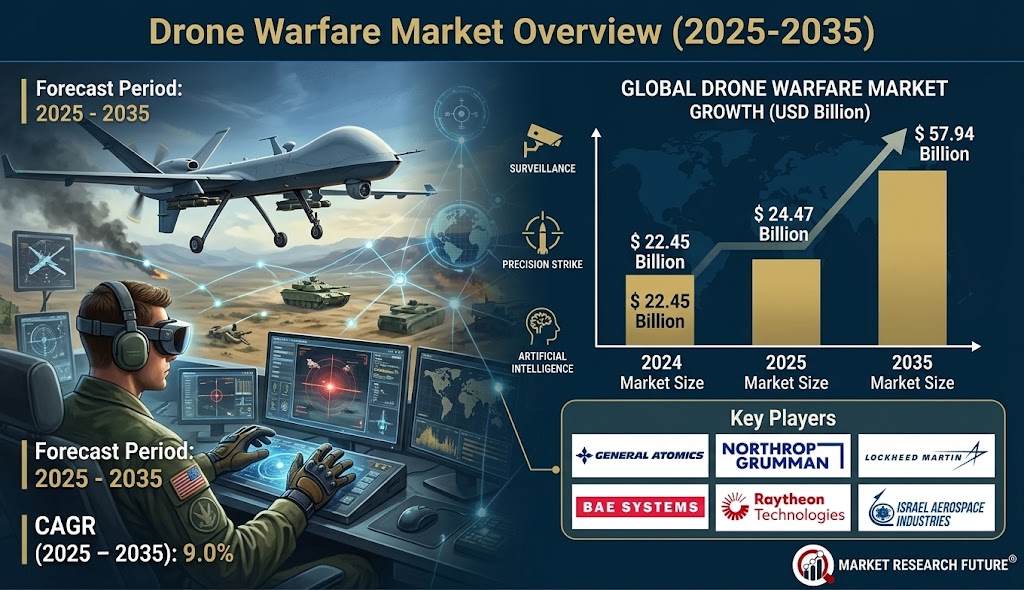
NEW YORK, NY, UNITED STATES, August 31, 2026 /EINPresswire.com/ -- The global Drone Warfare Market is entering a decisive decade of expansion as unmanned aerial systems become a central pillar of modern military doctrine. According to the latest industry analysis, the sector was valued at an estimated US$ 22.45 billion in 2024 and is on track to climb to roughly US$ 24.47 billion in 2025 before reaching approximately US$ 57.94 billion by 2035, reflecting a compound annual growth rate (CAGR) of close to 9.0% across the 2025–2035 forecast window. This trajectory underscores a fundamental shift in how nations equip their armed forces, prioritize battlefield intelligence, and manage the risks associated with contested airspace.The findings arrive at a moment when defense planners across North America, Europe, Asia-Pacific, and the Middle East are re-evaluating force structures in light of persistent regional conflicts, asymmetric threats, and rapid advances in autonomous systems. Unmanned aerial vehicles (UAVs) have moved from a supporting role to a frontline capability, delivering surveillance, precision engagement, and logistical support with a fraction of the risk to personnel that traditional platforms carry.
Market Snapshot:
Taken together, the numbers paint a picture of an industry entering a sustained growth cycle. This pace of expansion places drone warfare among the more dynamic sub-segments of the broader aerospace and defense industry, outstripping the growth rates typically associated with legacy platforms such as manned fighter aircraft or traditional ground vehicles. For stakeholders ranging from institutional investors to defense procurement officers, this sustained trajectory signals a long runway of opportunity in unmanned systems, associated software, and lifecycle support services.
Request for Free Sample of Report: https://www.marketresearchfuture.com/sample_request/21928
A Market Reshaped by Technology and Strategy:
Industry observers note that the drone warfare sector is being redefined by the convergence of artificial intelligence, advanced sensor packages, and autonomous navigation systems. These technologies are extending the operational reach of unmanned platforms, allowing them to execute increasingly complex missions with minimal human intervention. Swarming capabilities, in particular, are emerging as a focal point of research and development, enabling coordinated fleets of drones to overwhelm defenses, gather distributed intelligence, and strike multiple targets in a synchronized fashion.
At the same time, military establishments worldwide are channeling greater shares of their budgets toward unmanned systems. This reallocation reflects a broader recognition that drone technology offers a cost-efficient path to enhanced situational awareness and operational flexibility. Several nations are expected to raise overall defense spending by roughly 10% in the near term, with a meaningful portion of that increase earmarked specifically for drone development, procurement, and sustainment.
Regulatory considerations remain an important undercurrent in the market's evolution. As drone usage proliferates among both state militaries and non-state actors, governments are working to establish clearer frameworks governing deployment, airspace integration, and the ethical boundaries of autonomous engagement. How these frameworks develop will likely shape the pace and direction of innovation over the coming decade.
Key Growth Drivers:
Several forces are converging to propel the Drone Warfare Market forward:
Rising Defense Budgets. Governments around the world are directing increased capital toward unmanned aerial capabilities as part of broader military modernization efforts. This financial commitment is translating into expanded procurement programs and deeper investment in next-generation platforms.
Artificial Intelligence and Autonomy. The incorporation of machine learning and AI-driven decision-making into drone systems is enabling more autonomous and precise operations. Analysts estimate that the segment of the market tied to AI-enabled drones could expand by more than 20% in the near term, signaling strong appetite for intelligent, self-directing platforms.
Geopolitical Tensions and Asymmetric Threats. The growing prevalence of regional conflicts and non-state actors employing irregular tactics is pushing militaries to adopt UAVs capable of both surveillance and precision strikes. Budget allocations tied specifically to drone warfare capabilities are projected to rise by approximately 15% as nations respond to these evolving security challenges.
International Collaboration and Arms Trade. Cross-border partnerships are becoming a defining feature of the industry, as allied nations pool resources to co-develop unmanned systems and reduce per-unit costs. The global trade in drone platforms is expected to grow by roughly 12%, reflecting sustained international demand for advanced UAV technology.
Intelligence and Reconnaissance Demand. As battlefield operations grow more complex, the need for real-time situational awareness continues to intensify. Surveillance-oriented drones are expected to represent close to 40% of total unit sales, highlighting how central intelligence-gathering has become to contemporary defense strategy.
Segment-Level Insights:
The Drone Warfare Market is typically analyzed across four core dimensions: application, platform type, end use, and payload capacity.
By Application, surveillance currently commands the largest share of the market, a reflection of how essential continuous monitoring and reconnaissance have become to modern military operations. Enhancements in onboard imaging and real-time data analytics continue to reinforce this segment's leadership position. Meanwhile, combat operations represent the fastest-growing application category, propelled by rising demand for precision-strike capability and tactical flexibility on the battlefield. Reconnaissance and logistics support round out the remaining application areas, each contributing to the broader ecosystem of unmanned military capability.
By Platform Type, combat drones hold the largest share of the market, owing to their sophisticated weapons integration, targeting systems, and overall battlefield effectiveness. Reconnaissance drones, by contrast, are the fastest-growing category, benefiting from continuous improvements in payload technology and data processing that make them indispensable for real-time intelligence gathering. Cargo drones are also gaining momentum as militaries look to unmanned platforms to move supplies and equipment through difficult or contested terrain, easing logistical burdens without exposing personnel to unnecessary risk.
By End Use, the military segment remains dominant, accounting for the bulk of demand as armed forces integrate UAVs into surveillance, reconnaissance, and strike operations. Government agencies represent the fastest-growing end-use category, as drones increasingly support border security, disaster response, and law enforcement missions outside of traditional combat contexts. Private contractors constitute a smaller but steadily growing segment, often supporting military and government end users through specialized services and equipment.
By Payload Capacity, high-payload drones lead the market, reflecting their capacity to carry substantial weapons systems and advanced intelligence, surveillance, and reconnaissance (ISR) equipment for large-scale missions. Medium-payload drones are the fastest-growing category within this segmentation, as militaries increasingly favor platforms that balance capability with maneuverability and cost efficiency. Low-payload drones continue to serve niche roles where agility and rapid deployment take precedence over carrying capacity.
Regional Landscape:
North America remains the largest regional market, accounting for an estimated 60% of global drone warfare revenue. The region's leadership is anchored by substantial defense budgets, a mature innovation ecosystem, and supportive regulatory oversight from bodies such as the Federal Aviation Administration and the Department of Defense. The United States sits at the center of this landscape, home to several of the industry's most prominent manufacturers, while Canada continues to deepen its own investment in unmanned defense technology.
Europe holds an estimated 25% share of the global market and is expanding steadily as EU member states pursue coordinated defense initiatives amid heightened security concerns. Regulatory guidance from the European Union Aviation Safety Agency plays a key role in balancing military application with safe civilian airspace integration. The United Kingdom, France, and Germany lead regional activity, supported by close cooperation between government defense agencies and private industry.
Asia-Pacific, representing roughly 10% of the global market, is emerging as one of the fastest-growing regions as countries such as India and Japan expand their unmanned capabilities in response to shifting regional security dynamics. China's domestic manufacturers are playing an increasingly prominent role in the broader drone ecosystem, while India continues to build out indigenous development programs aimed at reducing reliance on imported systems.
The Middle East and Africa, holding an estimated 5% of the global market, is seeing accelerated investment driven by regional conflict, persistent security threats, and a growing emphasis on surveillance and reconnaissance capability. The United Arab Emirates and Saudi Arabia are among the region's most active investors, often working alongside established Western defense contractors to build out national capabilities.
Competitive Landscape:
The Drone Warfare Market features a moderately fragmented competitive environment shaped by continuous innovation, strategic alliances, and supply chain diversification. Leading companies participating in the space include General Atomics, Northrop Grumman, Lockheed Martin, BAE Systems, Raytheon Technologies, Israel Aerospace Industries, Thales Group, Leonardo S.p.A., and Elbit Systems, among others.
General Atomics has distinguished itself through sustained investment in AI-integrated unmanned aerial systems, positioning the company at the forefront of autonomous mission capability. The company recently formed a partnership with a technology firm to advance machine-learning-driven drone systems, a move expected to strengthen its position in next-generation autonomous operations.
Northrop Grumman has focused on geographic expansion and localized manufacturing to better serve international defense customers. The company recently secured a substantial contract to supply advanced surveillance drones to a European nation, reinforcing its growing footprint on the continent and signaling a broader trend toward cross-border defense procurement partnerships.
Israel Aerospace Industries has directed recent development efforts toward combat drones purpose-built for urban warfare environments, addressing the distinct operational challenges that dense, built-up areas present. This move reflects a wider industry trend toward specialization, as manufacturers tailor platforms to increasingly specific mission profiles.
Across the competitive field, companies are prioritizing localized production to reduce exposure to global supply chain disruption while accelerating delivery timelines. This strategic emphasis on manufacturing resilience, paired with ongoing investment in artificial intelligence and sensor innovation, is expected to define competitive positioning through the remainder of the decade. Industry watchers anticipate that differentiation will increasingly hinge on technological sophistication and supply chain reliability rather than price alone.
European players such as BAE Systems, Thales Group, and Leonardo S.p.A. are also expanding their footprint through government-backed collaborative programs, particularly as EU member states pursue joint procurement to reduce individual national costs while accelerating fleet modernization. In the Middle East, Israel Aerospace Industries and Elbit Systems continue to anchor regional development, frequently partnering with Western firms to adapt platforms for localized security requirements. Elsewhere, additional manufacturers active in adjacent unmanned systems markets, including firms based in China, are contributing to a broader global ecosystem of drone innovation that extends well beyond the traditional list of established defense primes. This widening base of participants is intensifying competitive pressure and, in turn, accelerating the pace of product development across the industry.
Outlook: Innovation and Opportunity Through 2035
Looking ahead, the Drone Warfare Market is expected to sustain its growth momentum at approximately 9.0% CAGR through 2035, underpinned by continued advances in autonomous systems, sustained defense spending, and evolving military doctrine. Several opportunity areas stand out for stakeholders across the value chain:
Autonomous Systems Development: Continued refinement of AI-driven drones capable of independent decision-making is expected to unlock new operational use cases while reducing reliance on human operators for routine missions.
Swarming Technology: The ability to deploy coordinated fleets of drones for combined surveillance and strike operations represents a significant tactical advantage that manufacturers are racing to perfect.
Maintenance and Support Services: As fleets of unmanned systems scale up across militaries worldwide, demand for specialized maintenance, repair, and lifecycle support services is expected to grow in parallel.
By 2035, the Drone Warfare Market is expected to represent a mature, technologically advanced segment of the broader aerospace and defense industry, characterized by deeper international collaboration, more sophisticated autonomous capability, and an expanding role in national security strategy.
Browse More Reports:
Electronic Warfare Market
https://www.marketresearchfuture.com/reports/electronic-warfare-market-1552
Robotic Warfare Market
https://www.marketresearchfuture.com/reports/robotic-warfare-market-21918
Underwater Warfare Market
https://www.marketresearchfuture.com/reports/underwater-warfare-market-21884
Market Research Future
Market Research Future
+1 855-661-4441
sales@marketresearchfuture.com
Legal Disclaimer:
EIN Presswire provides this news content "as is" without warranty of any kind. We do not accept any responsibility or liability for the accuracy, content, images, videos, licenses, completeness, legality, or reliability of the information contained in this article. If you have any complaints or copyright issues related to this article, kindly contact the author above.
